
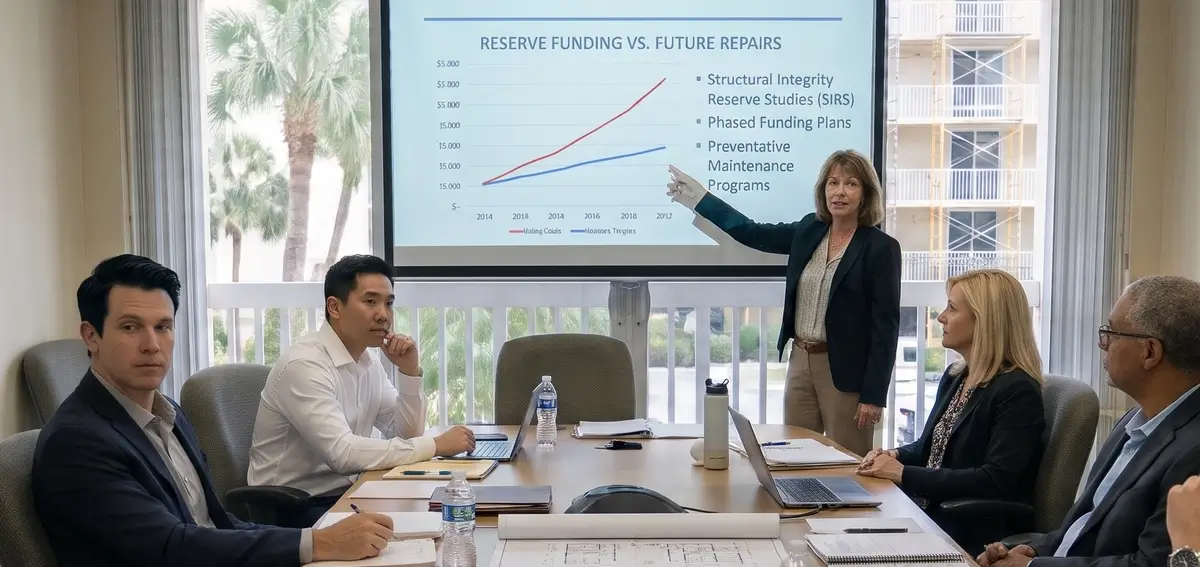
Volunteer board members already carry a full plate before a special assessment notice ever enters the picture, and most of them never signed up expecting to referee funding emergencies. Communities leaning on resources built for board members have noticed the same thing happening across Fort Lauderdale this year: assessments that used to show up once every decade are now landing closer to once every budget cycle. Storm exposure, insurance pricing, and aging infrastructure are colliding in ways that flat dues simply weren’t built to absorb.
Here’s what’s driving that shift locally and what boards can actually do about it.
Key Takeaways
- Reserve studies set years ago rarely reflect what insurance and construction actually cost today.
- Florida’s insurance market puts extra pressure on associations compared to most other states.
- A repair deferred for even one storm season tends to come back as an emergency bill.
- Transparent, frequent reporting helps homeowners accept an assessment instead of fighting it.
- How enforcement has been handled in the past shapes how residents react to a new financial ask.
Why Reserve Funding Keeps Falling Short
Most reserve schedules were written when roofing, drainage work, and insurance renewals cost a fraction of today’s prices. Few boards ever revisited those numbers once the market shifted, which left a growing distance between what’s saved and what’s actually needed.
| What the Reserve Study Assumed | What’s True in Fort Lauderdale Now |
|---|---|
| Roof and seawall repairs at older material rates | Material and labor costs well above original estimates |
| Insurance renewing at a flat, predictable rate | Annual premium increases, often with little notice |
| Contractors available within days of a bid request | Longer lead times and fewer competitive bids |
| Monthly dues set once and left unchanged | Dues falling further behind real costs each cycle |
Owners and investors often ask why their dues keep climbing even without an obvious project underway, and the honest answer traces back to this funding gap. It’s a conversation that comes up often in discussions about turning financial reports into real agreement among directors, since the numbers alone rarely settle the disagreement.
Florida’s Insurance Market Is a Bigger Factor Here Than Elsewhere
Few states feel insurance pressure the way Florida does, and Fort Lauderdale associations sit squarely in that reality. A few patterns show up across the board:
- Master policies covering common areas renew substantially higher than the previous term, sometimes doubling in a single cycle.
- Storm exposure keeps the state among the most expensive in the country for coverage.
- A lapse in coverage isn’t a workaround since state law requires it, it’s simply a bigger liability.
- Associations without a healthy reserve cushion end up passing the increase straight to owners.
Florida homeowners now pay an average of $2,691 a year for property insurance, a figure that’s risen nearly 50 percent since 2020. For associations managing shared structures and common areas, that increase compounds fast, and a renewal that outpaces the budget usually forces a choice between a steep dues hike or a special assessment.
A Real Example: What Happens When a Repair Gets Pushed Back
One mid-sized community near Fort Lauderdale offers a clear picture of how this plays out in practice.
Three Seasons of Warning Signs
The association’s reserve study flagged a failing roof drainage system three years running. Each year, the board chose to hold dues steady rather than raise them, worried that owners would push back on another increase. The board treasurer at the time later admitted she didn’t feel the community was ready to hear about yet another cost.
The Bill That Followed
A particularly wet hurricane season overwhelmed the compromised drainage system, sending water into several ground-floor units and damaging shared hallways. The emergency repair came in well above what a planned replacement would have cost a year earlier, and the board had no choice left except a special assessment due within 45 days, with no room to negotiate better contractor pricing under that kind of time pressure.
Communities that catch these warning signs earlier tend to do so because they’ve prioritized staying aligned on preventive maintenance before small issues become structural ones.
Weak Reporting Makes Every Assessment Harder to Defend
We’ve seen boards earn homeowner trust through steady, itemized reporting rather than a single explanation delivered after the fact. A few signs tend to show up before a funding gap turns into a surprise bill:
- Monthly financial statements arrive late or get skipped for a cycle or two.
- Reserve balances get discussed verbally at meetings but never appear in writing.
- Vendor invoices surface that weren’t part of any earlier budget conversation.
- Board members answer the same financial questions repeatedly because the numbers were never shared clearly the first time.
The median special assessment reached $1,100 per door in 2025, and that number tends to be highest in communities where reporting had already fallen behind. Volunteer boards juggling a heavy backlog of approvals rarely have the bandwidth to catch funding gaps on their own, which is exactly where consistent outside reporting earns its value.
Enforcement History Shapes How an Assessment Lands
Special assessments land hardest in communities where owners already feel shut out of board decisions. Associations that have leaned on strict, inflexible enforcement often see that frustration resurface the moment a financial ask arrives.
- Owners question the math even when the calculations are accurate.
- Meeting attendance spikes and conversations turn tense quickly.
- Unrelated rule disputes from months earlier get raised again during the vote.
- Some residents delay payment simply to register frustration with how the board handles things in general.
A homeowner who already feels unheard rarely gives the board the benefit of the doubt on a large bill, and he or she usually says so at the next meeting. Communities working through the balance between fairness and enforcement often find that same friction returns during assessment votes.
Steps Boards Can Take Before the Next Vote
How a board prepares before an assessment vote usually matters more than the final number itself. A short list of practical moves can reduce both the size of the bill and the backlash that follows:
- Pull the current reserve study and compare it against the association’s actual account balances.
- Request updated contractor bids rather than relying on pricing from a few years ago.
- Review delinquency rates closely, since unpaid dues often widen the funding gap further than expected.
- Share the full reasoning with owners before the vote takes place, not after the notice is mailed.
- Put scheduling routine compliance walkthroughs on the calendar so drainage issues, roof wear, and small violations get caught while they’re still inexpensive to fix.
FAQs about Special Assessments in Fort Lauderdale, FL
Can a board levy a special assessment without holding a formal vote?
It depends on the governing documents. Some allow the board to approve smaller amounts independently, while larger assessments usually require a homeowner vote that meets a specific threshold.
How does hurricane season affect the timing of special assessments in South Florida?
Many associations see assessments spike after storm season as deferred repairs surface or emergency damage exceeds what reserves can cover, especially in older drainage and roofing systems.
Does an unpaid special assessment follow the property if it’s sold?
Typically, the debt stays with the owner who was billed, but unpaid balances can still complicate closing, since many associations require the amount settled before ownership transfers.
Are condo associations and single-family HOAs subject to the same assessment rules in Florida?
No. Condominium associations often face stricter statutory requirements, including structural reserve studies, while single-family HOAs generally have more flexibility defined by their own governing documents.
What recourse does an owner have if they believe an assessment amount is inflated?
Owners can request an itemized breakdown of the costs, review recent contractor bids, and raise concerns at the board meeting, since associations are generally required to document assessment justifications.
A Clearer Path Forward for Fort Lauderdale Boards
Special assessments aren’t disappearing as a reality for Florida associations, and Fort Lauderdale communities feel that pressure more than most given the state’s insurance climate and storm exposure. Boards that stay ahead of it tend to share a few habits: updated reserve numbers, honest communication, and reporting that holds up to scrutiny before a vote ever happens.
PMI Broward Sunrise works with Fort Lauderdale associations to build exactly that kind of financial footing, so owners see the reasoning behind a decision long before the bill arrives. Review your reserve standing with our team and get a realistic picture of where your community stands before the next major repair forces the conversation.
